Galderma
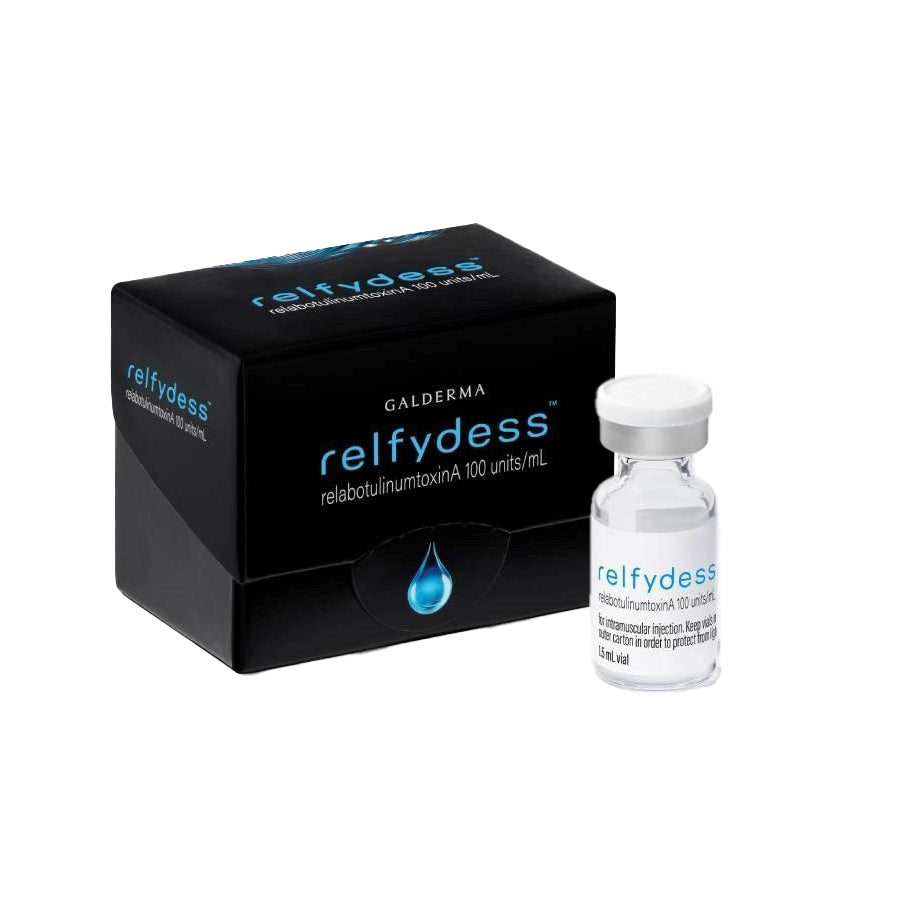
Relfydess™▼ (relabotulinumtoxinA) 100 units/ml 1.5ml Single Vial (POM) (cold chain)
Relfydess™▼ (relabotulinumtoxinA) 100 units/ml 1.5ml Single Vial (POM) (cold chain)
SKU: GALRELF100
Get a free Reladose Synringe 6 Pack when purchased with Relfydess. Click link to add free Syringes to your order.
This content has been developed by Galderma and is intended for Healthcare Professionals Only.
IE-REL-2600026 Date of Production March 2026
prescribing information and adverse event reporting can be found at the bottom of the page
Relfydess™▼ is indicated for the temporary improvement in the appearance of moderate-to-severe glabellar lines at maximum frown and moderate-to-severe lateral canthal lines at maximum smile alone or in combination, in adult patients under 65 years, when the severity of these lines has an important psychological impact on the patient. Relfydess SmPC
Relfydess™ ▼ (RelabotulinumtoxinA) is the first and only ready-to-use liquid neuromodulator created with PEARL™ Technology, developed and manufactured by Galderma. Relfydess SmPC
Relfydess™▼ 100 units/mL solution for injection - Prescribing Information:
Relfydess▼ 100 units/mL solution for injection - Prescribing Information (Ireland) – alternative version
▼This medicinal product is subject to additional monitoring. This will allow quick identification of new safety information. Healthcare professionals are asked to report any suspected adverse reactions. See ‘Undesirable Effects’ for how to report adverse reactions.
Presentation: Each vial contains 150 units of botulinum toxin type A 100 units/mL manufactured from Clostridium botulinum in 1.5 mL of solution.
Indications: Relfydess is indicated for the temporary improvement in the appearance of:
· Moderate to severe glabellar lines at maximum frown
· Moderate to severe lateral canthal lines seen at maximum smile
alone or in combination, in adult patients under 65 years, when the severity of these lines has an important psychological impact on the patient.
Dosage: The treatment interval should be no more frequently than every twelve weeks. The efficacy and safety of the repeated administration of this product has not been studied for more than 52 weeks. Consideration of the cumulative dose is necessary if other botulinum toxin products are being or have been used to treat other indications for those products. The potency units are specific to Relfydess and are not interchangeable with other preparations of botulinum toxin. Relfydess is ready-to-use with a concentration of 10 units per 0.1 mL and no reconstitution is required.
Dosing Instructions for Relfydess
|
Treatment(s) |
Total Recommended Dose |
Dose per injection |
|
Glabellar Lines (GL) |
50 units (0.5 mL) |
5 injections of 10 units (0.1 mL): 2 injections on each side at the corrugator muscle and 1 injection at the procerus muscle near the nasofrontal angle |
|
Lateral Canthal Lines (LCL) |
60 units (0.6 mL) |
6 injections of 10 units (0.1 mL): 3 injections on each side at the orbicularis oculi muscle |
|
Combined treatment of Glabellar Lines and Lateral Canthal Lines |
110 units (1.1 mL) |
11 injections total of 10 units (0.1 mL) for combined GL and LCL |
General information
In the event of treatment failure or diminished effect following repeat injections, alternative treatment methods should be employed. In case of treatment failure after the first treatment session, the following approaches may be considered:
· Analysis of the causes of failure, e.g. incorrect muscles injected, inappropriate injection technique, and formation of toxin-neutralising antibodies.
· Re-evaluation of the relevance of treatment with botulinum toxin A.
Paediatric population: The safety and efficacy of Relfydess in children aged up to 18 years have not been established. The use of Relfydess is not recommended in patients under 18 years.
Elderly population: There is limited phase 3 clinical data with Relfydess in patients 65 years and older.
Method of administration: Relfydess should only be administered by health care professionals with appropriate qualifications and expertise in this treatment and having the required equipment, in accordance with national guidelines and legislation. Intramuscular use. Dosing and treatment intervals depend on assessment of the individual patient’s response, but dosing should not exceed maximum doses allowed and the treatment interval should be at least 12 weeks. Each vial should be used for a single patient during a single treatment session only. Any residual product after the treatment should be discarded. Use aseptic technique and standard practice to prevent cross-infections. The median time to onset is 2 to 3 days, with some patients reporting an effect within 1 day. Treatment effect has been demonstrated for 6 months, with up to 75% of patients not returning to baseline. Glabellar lines: The recommended dose for the treatment of glabellar lines in adults is a total of 50 units/0.5 mL administered by intramuscular injection divided equally (10 units/0.1 mL per injection) into each of the 5 intramuscular injection sites: 2 injections on each side at the corrugator muscle and 1 injection at the procerus muscle near the nasofrontal angle. The anatomical landmarks can be more readily identified if palpated and observed at patient maximum frown. Before and during the injection, place the thumb or index finger firmly below the orbital rim in order to prevent extravasation below the orbital rim. The needle bevel should be pointed upward and medially during the injection. In order to reduce the risk of eyelid ptosis, the following steps should be taken:
· Avoid injections near the levator palpebrae superioris muscle, particularly in patients with larger brow-depressor complexes.
· Lateral corrugator injections should be placed at least 1 centimetre above the bony supraorbital ridge.
· Ensure the injected dose (volume) is accurate.
· Avoid injecting closer than 1 centimetre above the central eyebrow.
Lateral canthal lines: The recommended dose for the treatment of lateral canthal lines in adults is a total of 60 units/0.6 mL administered by intramuscular injection divided equally into 10 units/0.1 mL into each of the 6 intramuscular injection sites: 3 injections (30 units/0.3 mL) on each side at the orbicularis oculi muscle. Injections should be given with the needle bevel-up and oriented away from the eye in the lateral orbicularis oculi muscle. When lines in the lateral canthal region appear both above and below the lateral canthus, inject above and below lateral canthus. In case lines in the lateral canthal region are mainly below the lateral canthus, inject per below lateral canthus. Lateral canthal line anatomical landmarks can be more readily identified if observed and palpated at maximal smile. Care must be taken to avoid injecting the zygomaticus major/minor muscles to avoid lateral mouth drop and asymmetrical smile. Glabellar lines/lateral canthal lines combined treatment: For combination treatment of glabellar lines and lateral canthal lines, the respective individual dosing and administration should be followed for a total dose of 110 units/1.1 mL of Relfydess. The recommended dose for the treatment of glabellar lines is 50 units/0.5 mL (10 units/0.1 mL per injection) into each of 5 intramuscular injection sites and for lateral canthal lines is 60 units/0.6 mL (10 units/0.1 mL in each of 6 intramuscular injection sites).
Contraindications: Known hypersensitivity to any botulinum toxin products or to any of the excipients. Presence of infection at the proposed injection sites. Presence of myasthenia gravis, Eaton Lambert Syndrome or amyotrophic lateral sclerosis.
Precautions and Warnings: General: Relfydess should not be injected into a blood vessel. As with all intramuscular injections, use of Relfydess is not recommended in patients who have a prolonged bleeding time. Patients treated with the recommended dose may experience exaggerated muscle weakness. Each vial of Relfydess must be used for a single patient treatment during a single session. Any excess of unused product must be disposed of and specific precautions must be taken for the inactivation and disposal of any unused solution. Hypersensitivity reactions: Serious and/or immediate hypersensitivity reactions have been reported for botulinum toxin products and anaphylactic reactions can occur very rarely (see ‘Undesirable Effects’). These reactions include anaphylaxis, serum sickness, urticaria, soft tissue oedema, and dyspnoea. Equipment and medications (including adrenaline) needed to treat anaphylaxis should therefore be readily available. If such a reaction occurs, further injection of Relfydess should be discontinued, and appropriate medical therapy immediately instituted. Spread of Toxin effect: Post-marketing safety data from other approved botulinum toxin products suggest that botulinum toxin effects (such as diplopia, blurred vision and ptosis) may be observed beyond the site of local injection (see section 4.8). In addition, adverse reactions possibly related to the spread of toxin effect distant from the site of injection have been reported very rarely with botulinum toxin and may include asthenia, generalised muscle weakness, dysphagia, dysphonia, dysarthria, urinary incontinence, and breathing difficulties. These symptoms are consistent with the mechanism of action of botulinum toxins and have been reported hours to weeks after injection. Swallowing and breathing difficulties can be life threatening and there have been reports of death related to spread of toxin effects. Patients with pre-existing swallowing or breathing difficulties may be more susceptible to these complications. More specifically, following treatment with botulinum toxin, very rare cases of death have been reported in the context of patients who have dysphagia, pneumopathy, or significant asthenia. Therefore, Relfydess is not recommended in such patients. Patients or caregivers should be advised to seek immediate medical care if swallowing, speech or respiratory disorders arise. Pre-existing neuromuscular disorders: Relfydess should be used with caution in patients with a risk of, or clinical evidence of, marked defective neuro-muscular transmission. These patients may have an increased sensitivity to agents such as botulinum toxin, and excessive muscle weakness (including systemic effects of severe dysphagia and respiratory compromise) may follow treatment. In some of these cases, dysphagia has lasted several months and required placement of a gastric feeding tube. Pre-existing conditions at the injection site: Caution should be taken when Relfydess is used in the presence of inflammation at the proposed injection site(s) or when excessive weakness or atrophy is present in the targeted muscle(s). Caution should be used when Relfydess treatment is used in patients who have marked facial asymmetry, ptosis, excessive skin laxity (such as dermatochalasis), deep dermal scarring, or thick sebaceous skin. Ophthalmic adverse reactions: Dry eye, reduced tear production, reduced blinking, and corneal disorders may occur with the use of botulinum toxins. If symptoms of dry eye (e.g., eye irritation, photophobia, or visual changes) persist, consider referring the patient to an ophthalmologist. Increased lacrimation may occur with the use of botulinum toxins. Muscle atrophy: Muscle atrophy is expected after repeated botulinum treatment secondary to the flaccid paralysis of the treated muscles. Antibody formation: Injections at more frequent intervals or at higher doses may increase the risk of neutralising antibody formation to botulinum toxin. Clinically, the formation of neutralising antibodies may reduce the effectiveness of subsequent treatment. Traceability: In order to improve the traceability of biological medicinal products, the name and the batch number of the administered product should be clearly recorded. Potassium and Sodium content: This medicine contains potassium, less than 1 mmol (39 mg) per 150 units vial, i.e. essentially ‘potassium-free’. This medicine contains less than 1 mmol sodium (23 mg) per 150 units vial, i.e. essentially ‘sodium-free’. Polysorbate 80 content: This medicine contains 1.6 mg of polysorbate 80 per 150 units vial which is equivalent to 1.1 mg/mL. Polysorbates may cause allergic reactions.
Interactions: No drug interaction studies have been conducted. Concomitant treatment with Relfydess and aminoglycosides or other agents interfering with neuromuscular transmission (e.g. curare-like agents or other botulinum toxin products in other locations) should only be used with caution since the effect of botulinum toxin may be potentiated.
Pregnancy, Breastfeeding and Fertility: Pregnancy: There are no adequate data from the use of botulinum toxin type A in pregnant women. Animal studies do not indicate direct or indirect harmful effects with respect to reproductive toxicity other than at high doses causing maternal toxicity. The potential risk for humans is unknown. Relfydess should not be used during pregnancy and in women of childbearing potential not using contraception. Breastfeeding: It is unknown if Relfydess is excreted in human milk. The excretion of Relfydess in milk has not been studied in animals. Relfydess should not be used during breast-feeding. Fertility: There are no clinical data examining the effect of Relfydess on fertility. There is no evidence of direct effect of botulinum toxin A on fertility in animal studies.
Effects on ability to drive and use machines: Other botulinum toxin products have been reported to have a minor or moderate influence on the ability to drive and/or use machines. There is a potential risk of localised muscle weakness or visual disturbances linked with the use of Relfydess which may temporarily impair the ability to drive or operate machinery.
Undesirable Effects: The majority of adverse reactions reported after one treatment with Relfydess in subjects receiving ≥ 50 units in all placebo-controlled studies in the development program were of mild to moderate intensity. The most frequently reported adverse reactions were injection site reactions and headache occurring in approximately 7% and 5% of subjects, respectively. In general, treatment/injection technique-related reactions occurred within the first month following injection and were transient. When glabellar lines and lateral canthal lines were treated in combination, the nature and frequency of adverse reactions were comparable to what was observed when patients were treated for the individual indications. The following adverse reactions were observed in patients that were administered Relfydess for the temporary improvement in the appearance of moderate to severe glabellar lines: Common (≥ 1/100 to < 1/10): Headache, eyelid ptosis, injection site reactions (e.g. bruising, swelling, pruritus, pain, discomfort, haematoma, hypersensitivity and warmth), uncommon (≥ 1/1,000 to <1/100): Hypersensitivity, visual impairment, dry eye, asthenopia, brow ptosis, urticaria, muscular weakness, muscle spasm. The following adverse reactions were observed in patients that were administered Relfydess for the temporary improvement in the appearance of moderate to severe lateral canthal lines: Common (≥ 1/100 to < 1/10): Headache, injection site reactions (e.g. erythema, pain, and bruising), uncommon (≥ 1/1,000 to <1/100): Hypersensitivity, dry eye, asthenopia, swelling of eyelid, muscular weakness.
Prescribers should consult the summary of product characteristics for further details.
MA Number: PA1613/005/001
Legal Category: POM
Further information is available from: Galderma (U.K.) Limited, Evergreen House North, Grafton Place, London, NW1 2DX, United Kingdom, Tel: +44 (0)300 3035674.
Date of Revision: January 2026
IE-REL-2600001
▼ This medicinal product is subject to additional monitoring. This will allow quick identification of new safety information. Healthcare professionals are asked to report any suspected adverse reactions. See below for how to report adverse reactions:
Suspected adverse events can be reported via HPRA Pharmacovigilance, Website: www.hpra.ie;
Adverse events should also be reported to Galderma (U.K.) Limited and Healthxchange Ireland Limited.
E-mail: medinfo.uk@galderma.com Tel: +44 (0)300 3035674
E-mail: orders@healthxchange.ie Tel: 01 456 8360